Wednesday, November 13, 2024

The Measure of a Man

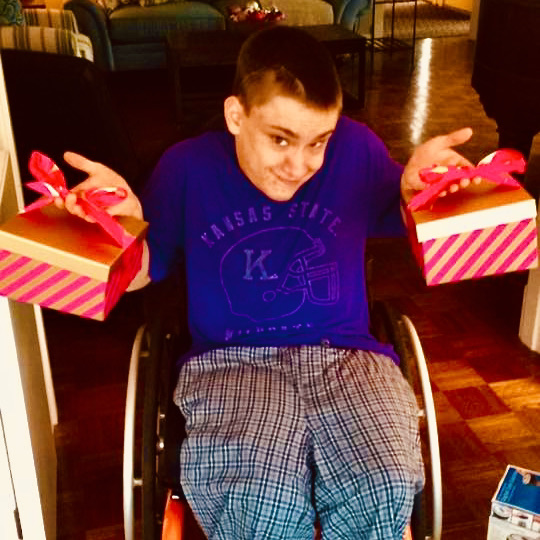
 They never measured his height. Only his weight. We’d have to get him out of his chair at the doctors and he would lie on the scale. He knew how much he weighed. He wanted to know how tall he was-or how tall he would be if he could stand.  We’d occasionally have him lay on the floor with a measuring tape in hand.  One of us would try to stretch his mangled legs straight while the other would approximate a measure.  5’3” or 5’4”.  He loved it that he was taller than Katie.  His wingspan was huge, more like the wingspan of somebody 6’3” or so. 

What was it like, not having the measure of oneself?  To know one’s weight but not one’s height?  To know how much one’s mass presses on the earth, but not how high one could potentially reach toward the heavens? I think sometimes that was Griffin’s struggle with depression, weighed down to the earth with no ability to escape its gravity, if only even temporarily?

Research in neuro-science has shown us that the body stores emotions.  Stress, anxiety and depression from yesterday or years ago can manifest itself in our bodies.  Unexplained back pain, illnesses and depressed immune systems can be metastasized emotions we’ve been suppressing, ignoring or even dwelling on.  For Griffin it was in many ways the opposite: his body created emotional reactions. Imagine being a 6’3” spirit in a 5’3” body confined to a 4’3” chair.  There were so many nights we spent in wordless grief together.  He couldn’t, or maybe wouldn’t, give words to the gravity he felt pulling him inward.  And the more he couldn’t slip the surly bonds of earth the deeper inward he grew.

Perhaps most painfully there were no words for me, either.  How does one explain the inexplicable to your only boy, or soothe a pain that is unsolvable?  All I could do was hold him for both of us.  For him to feel the arms of his father around him.  For me to keep him from slipping further away into himself.


Even as I write this I ache.  Even as I write this I hold the hope that there is a Heavenly Father who is holding me, feeling my pain as I felt Griffin’s.  I hold the hope that God will grasp my hand and keep me from slipping deeper into my distractions, hold me in His arms as I turn inward from the body, through the soul and finally home into the spirit where he dwells with me.


Tuesday, December 19, 2023

Waiting On God (And A Yellow VW Squareback)

I am an impatient person.  I hate being on hold, am an habitual speeder on the road and have been known to leave an entire shopping cart of groceries if the store is missing a key item.  Compounding my impatience is my addiction to distraction.  The four person wait in line at a store is taken up by scrolling through Facebook, ESPN, The New York Times and whatever I can find to soothe my irascible soul.  Like any addiction, the distraction becomes habit and has seeped ever gradually into other areas of my life as I squander our most precious resource, time, binging shows and story-bouncing down the rabbit hole of the internet only to look up and find the clock much further ahead than I had intended.

Where in this ecosystem do I therefore find the time to wait on God?

Much is written in Christian circles on seeking God.  On cultivating your journey with Jesus.  And I spent many years investing the majority of my spiritual time seeking Him, His will and my purpose in life.  It’s only been here, in my later years, that I have discovered the sacred value in simply being found.  “Be still and know that I am God” (Psalm 46:10) has resonated with me these past few years and in those rare moments that I have accepted that invitation I have been struck dumb by the experience.  I have reflected on it and the story of the Prodigal Son keeps calling to me for an entirely different reason.

My reflections on the Prodigal have always focused on a couple of different aspects.  The first is the response of the younger brother’s indigence and his father’s explanation of grace.  The second has been the father’s response to the wayward son, the extravagant display of celebration at his return as a guidepost to God’s response when we turn to him.  But what has taken me of late is the idea of the father running toward his Prodigal.  We often used that in Young Life talks as a way to explain God’s fervent desire to be reunited with us, His creation.

What has caught me, though, is a more subtle thought on that simple act of running.  Who knows if that Prodigal would have walked through that gate if his father hadn’t run to him?  Would he have simply stood and stared at what he had squandered, covering himself in a blanket of shame and simply wandered back out to the wilderness?  What strikes me is not the act of running as desire.  It is the act of running as remembrance.  Running to that wayward young man reminded the son of what he had always known in his soul: his father was seeking him, always.  All he had to do, really, was stop his endless distractions in gambling and excess and wait for his father to find him.  That he made the effort to find his way home was an added bonus.  His father running to him was proof that if he had simply stopped and been still, anywhere in the world and sent a note to his father his father would have found him.  As the old hymn says, “I once was lost, and now am found.”  Not finding, a verb, but found, a noun.  Not a doing. A being.

So if we can know that God will find us if we will only wait on Him, why do we find it so difficult to do that?  We can blame our world and its endless distractions or blame ourselves for our endless well of impatience.  But those are the symptoms, not the disease.  And I think the disease comes down to trust.

Can we trust that if we are still and wait on God to find us, will he make the effort?  For far too many of us the answer is no.  That no is rooted in the failings of the people most important to us in our most vulnerable moments of development.  

For me, the picture I draw in my mind’s eye is of an nine year old looking out the window on a Friday afternoon.  My parents were divorced when I was six months old and it was acrimonious.  My father’s own childhood background could be its own book, but suffice it to say he was not equipped to be a father of three children and even less equipped to pursue those children as a weekend dad.  By the time I was nine my older brother and sister had long given up on him as an active part of their lives, but I yearned for that connection.  323-6880.  That was his home number.  543-2210 was his office.  I called those numbers enough times to remember them as I approach 60 by heart.  This was in the days before answering machines, so the phone would ring and ring and ring and ring.

On those occasions we would connect, I would work out a weekend that worked for him for me to come down from Everett to his home in the Montlake District near the University of Washington.  There wasn’t much to do there.  Dad and his wife, Judy, were into galleries and organic food and plays.  Snore.  And there was only one kid on the block my age, Dimitri, and his parents were divorced as well so finding him was a lottery win.  But simply having time with Dad was its own reward, so I pursued those weekends with the effort I now use to pursue new clients.

So, to that nine year old on the couch, looking out the window, he was waiting for his dad’s yellow VW Squareback to meander down the road to his house to pick him up.  On more occasions than once, it never arrived, the light of an early spring afternoon gradually fading to dusk and with the onset of dark the stark realization that a weekend so anticipated was now dissipating into the pain of unintended but very real rejection.  The phone call usually came late on a Saturday morning: a work trip went late or a big project had appeared.  Maybe the weekend after next.

Is it any surprise that we have a difficult time waiting on God, when for so many of us waiting brought us only pain?  That the life lesson we drew from this and hundreds and thousands of similar and equally devastating disappointments was that we were on our own?  That to find joy and happiness required relentless effort to pursue?

In this light it’s no surprise that the seeking of God is what is so attractive about Christianity for a group of us.  We know only that that which we seek; that which we scrap for is what we can hope to receive.  And yet at its core, this belief in seeking really runs counter to Luther’s founding concept.  We cannot earn God’s grace, it can only be received.  It is only in these later years, after the brushing and bruising and wearing and tearing that life inevitably brings that I have truly understood this concept of grace.


So here I sit, like that nine year old looking over the back of the sofa through the window to the road, waiting.  Trusting but not knowing that my God will find me.  All I have to do is want and wait.  He hasn’t disappointed me, yet.  He doesn’t always work on my schedule, but He works. If only I am patient and understand that the value is in the stillness as well as the knowing.


Thursday, November 30, 2023

Here Comes The Sun (Hopefully)

I was sitting one morning in my office, where I should be working, instead reading Alan Watt’s “The Wisdom of Insecurity” over a cup of coffee and enjoying the view of downtown Buckhead in Atlanta.  My AirPods were in ear, a playlist of classical guitar rolling through song after song of veritable white noise for reading.    

I am beginning Watt’s book as part of some rabbit-holing I’m doing on two of my favorite authors, Richard Rohr and Clay Christensen, cite.  I know, odd pairing, a monk and a Mormon business guru, but that’s for a different story.  The foreword of Wisdom is a treatise on the difference between belief and faith.  Belief, Watt’s says, is a clinging “where the believer will open his mind to the truth on condition that it fits in with his preconceived ideas and wishes.”  Faith, he counters, is a letting go, ungrasping of preconceptions.  “If you try to capture running water in a bucket, it is clear that you do not understand it and that you will always be disappointed, for in the bucket the water does not run.”  Restated, to have “running water” you must let go of it and let it run.  The same is true of life and of God.”  Reread that last bit.  I did, four times before the levity of the truth began to sink in.

As I pondered this fathomless truth, an easter egg appeared in my AirPods: a classical rendition of George Harrison’s “Here Comes the Sun” performed by Pedro H. Da Silva and the Academy of St. Martins in the. Field.  

It was a revelation. 

George’s masterpiece of modern pop music appeared unadorned of his mournful, hopeful lyrics and it was a revelation.  The true genius of the music he wrote was revealed.  The lyrics are all about the promise of a new day, a new season, a new hope:

Little darlin', it's been a long, cold, lonely winter 

Little darlin', it feels like years since it's been here

Here comes the sun, doo-doo-doo-doo

Here comes the sun, and I say

It's alright

And yet the impact of Harrison’s studies in his newfound faith, Hare Krishna, can be found in the chord progressions throughout the song.  The song is built on a pentatonic scale, five notes per octave and ascend from E to C# as the song begins.  Hope in the flat pick of Harrison’s guitar.  You can hear the sun rising above the ocean on a cloudless day on a sandy beach.  So in accord with his hopeful lyrics.  But the revelation comes in the bridge which is an ascension from C to E7: as surely as the sun rises, it will set again.  The entire composition seems to be written as an ode to his faith that as surely as the sun rises, it will set.  And as surely as it sets, it will rise again.  However this is a faith in the surety, not a belief.  The syncopation, the chord progressions are at once assuring and mildly disconcerting.

Much as Watt’s argument for faith over belief is disconcerting.  And assuring.  Life is too big to be bottled in beliefs.  Because beliefs become certainties and certainties always lead to tragedy (I could spend pages on how this occurs, but simply ponder our government’s certainty that there were WMDs in Iraq and start doing your own rabbit-holing on how certainties lead to tragedy).  Religion of any kind loses its way when it clings to doctrine instead of having faith in the God it worships.  For me, the God in whom I have faith came to earth in the form of Jesus.  But it is only faith that I have in the hope Jesus brings.  Not certainty.  Hell, I’m not even certain any of it is true.  But my experience seems to largely match what the Man said, so I’m choosing to have faith.

Yet most of us, well me, spend our lives clinging to a belief that the future in this life can be made certain and it is most decidely not.  Tragedy happens.  I know that all too well.  My son was born with a disability and died tragically, choking on aspirated food, when he was 22. And  yet and still I attempt to construct a life that guarantees me happiness.  Watts argues, rightly, that my construction is in vain.  My search for a God that will ensure me a certain life full of only gifts and never tragedies is a myth.  C.S. Lewis captured it in a children’s book:


“Aslan is a lion- the Lion, the great Lion." "Ooh" said Susan. "I'd thought he was a man. Is he-quite safe? I shall feel rather nervous about meeting a lion"..."Safe?" said Mr Beaver ..."Who said anything about safe? 'Course he isn't safe. But he's good. He's the King, I tell you.”

― C.S. Lewis, The Lion, the Witch and the Wardrobe

As long as we cling to certainty, we cannot find faith.  Certainty cheapens faith.  It conjures a world where every tragedy has an intended purpose, denying us the reality of what is truly in front of us in the now.  Our mortal coil indeed has an end.  Our parents, our friends, our children die and are longer with us.  It stings, it aches, it itches in a place that nothing and nobody can scratch.  And to salve that with a bromide that “don’t worry, they’re with God now” only goes so far.

Which returns us to Watts, who seems to be urging us to face life in the now.  Don’t avoid pain, embrace it.  “For whosoever would save his soul will lose it”, Jesus tells us.  We struggle with this verse as it hits at the motivation for our tendency toward religiosity: control.  We cannot save our souls, only God can. 

That is a painful realization.  Bad things can and will happen.  We can’t stop them.  We can’t validly explain their purpose and frankly attempting to explain them is just a way of avoiding their pain.  Every attempt to avoid that pain is an attempt to save our own souls.  And paradoxically, we cannot truly know joy unless we’ve known pain.

Pain and joy: they are like the rising and setting of the sun.  We can only truly appreciate the rising of the sun when we’ve seen it set and lived through the dark night of the soul.  And we can only truly appreciate the setting of the sun if we have a faith that it will indeed rise again.

They are like the ascension of chords, only appreciated fully by the hearing of a descension.  They are like the Resurrection, only appreciated fully in a truer understanding of the Crucifixion.  More on that in a different post.  Meanwhile…


Here comes the sun, doo-doo-doo-doo,

Here comes the Son, and I say

It’s alright


Wednesday, September 7, 2022

A Story Of A Tree

In the middle of a dense forest there was a clearing. In the center of that meadow, truly the center weather stepped off or measured by laser, stood a tree. To the untrained eye it wasn’t especially unique other than it stood by itself, separate from the other trees. It’s leaves were a brilliant green, much like the other trees leaves were in spring. And as the wind blew leaves flew around that tree just as the other trees did during a breezy day. If one were to visit that meadow more than once in a year, one would notice that this trees leaves never changed. As the leaves in the forest turned red or yellow and finally a brown that is nearly black this tree’s leaves remained a radiant green. The leaves in the forest would gradually lose energy, separate from their branches and fall gracefully to the earth from which they sprang, molt and die. After many visits one might begin to notice that the brilliant green leaves of the tree in the middle of the meadow never quite fell to the ground, rather circling the tree in a delicate dance. In fact one might notice that as the tree grew leaves didn’t spring from its branches, rather the leaves circling the tree would, one by one, reattach themselves to the tree. Suddenly this tree would seem not only unique, but remarkable. And if one made one’s life a pilgrimage to that tree, one might begin to notice that they themselves are a leaf, circling that tree. And in this awareness one might begin to gradually stop studying the tree and start to enjoy the feeling of fluttering in the wind, the worries of the world that one brought to this meadow in a dense forest would fade away. If one looked around as one fluttered, one would feel lost as the forest through which they tromped is no longer there. And in that moment they might begin to feel very small, yet more important than ever. Even vital. If they leaned into the fluttering and made it their sole purpose, they might begin to notice that they aren’t fluttering at all, but ascending toward that newest branch. And they might even notice the other leaves fluttering beside them, also ascending. They would begin to notice the size and scope of the tree, seeming to have no beginning or end. The tree would feel both surprising and familiar in the same breath. Your fluttering would become your purpose, worrying not at all about the ascent or descent as you would know from where you came and where you are going. And in this knowledge, you would know who you are. You would know that you are not important, your life away from the tree is limited and your destination is simply back from where you were separated. This is the story of tree. The story of you. And the story of me.

Sunday, September 4, 2022

The Cold Gray Dark Of Dawn


In the cold gray light of the pre-dawn hour, I awoke from a dream.  Griffin was a toddler in body but a man in spirit.  I was holding him by his arms and he was moving his legs to convince the doctor that he could walk if only he could will his unwilling limbs.  He was pleading that his will was strong enough and with the doctor’s trust in his will it would be so.


I waited in bed, half asleep, recalling a dream as it unfolded.  I tried to will myself back to that place where I held my child by his hands as he walked as a man while still a boy.  Back to a place that was real, but never existed.  A place where I was giving him that which he never received.  But it was gone.  So my eyes finally opened and I was back to my reality.  I wept quietly, somewhat embarrassed.  That cold gray light, where colors are absorbed into nothing, and everything, is where I awoke.  And where I live.

There are moments like a dream, where the world unfolds in all its shades and shapes and I am fully alive.  And so is he.  I grasp at those moments like Jacob grasped at God in the tent, trying to wrestle that glimpse of paradise into submission so it won’t ever go away.  But it does, as it always will until the day we are truly named.  

And there is no blessing from God like Jacob received, simply the blessing of knowing that wrestling with God is the journey and the path to receiving our true name.  And also the blessing of knowing that what we see as light and color and fulness today, the now and the present is only the cold gray light of the pre-dawn hour before heaven and earth become one.  There our dreams open our eyes and we see what is and was always real.  That our fulness comes not from our conquests and our triumphs, but rather from our wounds.  Wounds that are, to paraphrase Leonard Cohen, the cracks that let's the light in.;


Friday, March 11, 2022

The Space Between


There is a space between 
the taking and the letting 
of each breath drawn cross our lips.
Our chest filled with air,
we don’t hold the breath
as much as pause
and ponder that
each life begins
with an inhale.
An each life ends
with an exhale.
And between the two
Is a space
just large enough for God to fill,
whether over the whole of life
or just one single breath.

Wednesday, March 9, 2022

Breath

Life begins for each of us with an inhale.  And it ends, for all of us, with an exhale.  They are, biologically speaking, involuntary responses from the autonomic nervous system.  In between those two breaths we have choice: we can allow our autonomic nervous system to control our every breath, or we can, from time to time, take control of our breath and become aware of the miracle of breathing.  


We can feel the coolness of the air passing into our nostrils and the warmth of our body as it passes back out.  We can feel our belly rise and fall.  We can sit in wonder as we picture that life giving breath filling every capillary in our lungs, providing oxygen to our blood.

Most of all we can simply pay attention to our breath, slowing the pace of our racing thoughts to a crawl and then a standstill.  And in the silence of our own being we can for once, be.  And we can experience the wonder of a breath taken.  The miracle of a breath released.  And if we pause in between for just a moment between inhale and exhale, hold that involuntary response to release, we might just find a space as large as eternity and as small as that moment.  A space that is just large enough for God to reveal himself and small enough for us to understand his love.

Breath.


Monday, March 7, 2022

The Great Before

This is a photo from the great before.  We four were at a Braves game on Family Night, the guests of an incredibly proud Griffin.  My work affords me front row seats right behind home plate, in front of the Braves batting circle with a gourmet buffet.  But as we waited out a rain delay and took our hot dogs and beers to sit as far from home plate as you can get in Truist Park, we were sitting in the best seats in the house. Griffin’s gift to us.


That’s the thing about great befores. They’re nostalgia.  Nostalgia is a Greek word formed from two words: nostos, meaning homecoming, and algos, meaning pain or ache.  The word was coined by a 17th century physician to describe the homesickness Swiss mercenaries felt when they were hundreds of miles away from home.  In the wake of the great before, nostalgia is the pain of a wound that won’t heal because somebody you love isn’t coming home.  And the only healing of that pain is when finally you’ve come home to them.

It's hard to believe that we are more than two years past my son’s death.  And the pain, if anything, is more intense than it was in the days and weeks after his passing.  The difference is only my ability to stow away those feelings just long enough each week that life can move forward.  And then there is the moment the photo appears on a screen saver and I look past the four people in the photo and remember the fifth in our family who isn’t in the photo, or in our lives except in our memories.

This was the great before.  And now we live with the pain of loss with only the hope, the belief in the great hereafter.


Sunday, February 6, 2022

For The Heartbroken...

I woke up this morning and scrolled through Facebook and the second post I saw was a friend from high school mourning the loss of her mother.  I turned 58 years old this year and it seems there’s not a day that goes by that I don’t see a post like that one.  And it caused me to think about the nature of mourning.  Times of loss like a divorce, the loss of a parent or a good friend are heartbreaking experiences.  And we’re programmed to avoid pain; it’s in our DNA.  And these kinds of experiences are incredibly painful.  So it’s not a surprise that the first stage in the grieving process tends to be denial.  

Denial gets a bad rap in our society.  Denial in the early stages of grieving is simply nature’s way of telling you that you’re not ready to handle what’s in front of you.  But all to often we stall there and find ways to numb the pain.  We typically think of numbing as being substances and it often is.  But just as often we numb ourselves with distractions: we busy our schedule with chores or extra responsibilities.  I find myself binge watching television as an avoidance mechanism.

There comes a moment, though, when denial has run its useful course and it is time to deal with the painful emotions we’re feeling.  Time to uncork and unpack what life has left at our doorstep.  And that process requires courage. 

It’s a courage that is in short supply.  Because when it comes to our emotional and spiritual health we spend scant minutes a day if anything at all looking inward, sitting silently and listening more through ourselves than to ourselves.  Listening through is a listening that transcends us and becomes an all way conversation with God about what is rather than what I want it to be.

I must admit that I’m new to this kind of listening.  I must also admit that it was great tragedy that led me to trying this kind of listening through myself.  (I won’t bore you with the details other than to say this: a life threatening health scare and a global pandemic nearly broke me; the loss of my son Griffin most surely broke my heart.)  More often than not, as Fr. Rohr has written on dozens of occasions, it is these kinds of tragedies that instill in us a need for something transcendent.  We can either choose to remain heartbroken and allow the heart to  harden into bitterness, envy and contempt.  Or we can allow our heart to be broken open where it can be renewed and refilled by a union of with the One.  It’s not so much that He fills it as our hearts are mended together in these moments.  And I find the courage to face my loss and look beyond myself and see the needs of the others in my life and hopefully have something of value to offer having had the chance to listen through myself and find More. 


Tuesday, July 13, 2021

On The Naked Now. A Thought For A Good Friend


Being present to the naked now is as difficult and painful as balancing on the sharp point of a needle.  The concentration necessary to balance on that point is impossible so it is only through grace that we find that balance.  We wander away into thoughts and as we become aware of our wandering we judgelessly return to the present.  And through grace, begin again.


It is also painful.  Placing the full weight of our presence on the sharpness of the naked now pierces the soul.  Nobody ever died from a pin prick, but it can feel as if we might.  Our awareness brings to light pains repressed, regrets unresolved, relationships unhealed.  And, then, again, we return to the breath and the naked now resolved to live into the truth that Fr. Rohr expressed: “God does not love us because we are good. God loves us because God is good.”

Blessings this day, my friend.  God loves you and so do I.

Monday, June 28, 2021

The Invisible Man


As I prayed this morning, I asked the question, “What are we working on, Father?  Where are You trying to lead me.?”  I’ve been thinking a lot lately about my ego and my attachments and the need to let both of them go.  But then I heard a whisper.  

“Enter into the pain.”  

It may have been God or maybe it was just my subconscious.  Either way it was a reminder of what Richard Rohr has said and written: “That which you do not transform you will transmit.”  It is still raw to think of Griffin’s passing, to imagine him struggling for breath alone amidst a dozen or more people.  He died in some fashion the way he lived when he was outside the environs of his family: invisible and alone.
How does one transform that reality into something good?  Where is the relief from that painful memory?  Where was God in that moment in time?

“I AM WHO I AM,” Yahweh told Moses.  Is it mine to ask where God was when Griffin struggled to draw his last breath?  Was I there when God breathed into Adam his first breath?  These questions are in so many ways just a way out of dealing with the pain of this loss.  Grief is so much more manageable in the head than in the heart.

The purpose of grief isn’t to manage it.  It is to walk with it, into it and maybe finally through it.  It is primarily a journey of the heart.  To willingly allow one’s heart to be broken a thousand times over only to be healed a thousand times more.  Grief is the place where we reconcile the unholiness of our loss with the holiness of Griffin’s gain.  Reconcile all the ways we failed him with all the ways we were uniquely equipped to be his parents.  Reconcile the bright, shining light Griffin could be with the dark, stormy interior life that was his prison.  Reconcile a world that was at once full of the most generous human beings that surrounded and celebrated Griffin with the cold world he entered when he left our home, a world where he was invisible enough to die choking in the corner of a room full of people.

This is my pain that needs transforming, lest I continue to transmit it.  

Pray for me.


Tuesday, April 13, 2021

My So-Called Superpower

I used to believe that the fact that my mind was in constant motion was a superpower.  Thinking about problems at work while mowing and trimming my near perfect lawn helped me “see around corners” and anticipate problems and dangers.  I would put my anxious mind at ease by devising solutions and crafting conversations that  would get me out of any bind I was in.

I can see now that that superpower was really a sickness.  A cancer of control that was poisoning professional relationships on multiple fronts.  My superpower allowed me to bend facts with words that planted seeds of ideas I could sow when it suited me.  And while that worked at times, the end result was relationships where trust was in short supply or about to be in short supply.  I was, unawaredly, gaslighting those around me.

The cancer metastasized in other ways, too.  One was the simple fact that a mind that cannot be calmed and quieted has an impenetrable barrier to self-awareness.  Only in the quiet of intentionally not thinking can we truly see ourselves and understand how temporal our thoughts are and that we are not what we think or feel.  I was one who overidentified with whatever I was thinking or feeling in the moment.  Happy, sad, competent, a failure: these were not simply feelings or thoughts, they were who I was and how I presented to the world.  So on any given day I might be owned by happiness and bring joy to the office.  Or I might be owned by frustration and bring disruption.  It has taken me all these years to understand just how insubstantial my thoughts are and yet how substantial I am in the eyes of God.  And what a difference that brings to how I present to the world.

The Buddhists have a concept of “not self”, the idea that all of the ways we identify ourselves as unique and separate beings from the world as a whole are an illusion.  That when we spend time examining our thoughts and the emotions they cause, there is no controlling “I” at the  center creating those thoughts.  They are like the weather.  They come and they go, conditions change and then they change again.  Perhaps this is what Jesus was describing in Matthew 10:39—That it is only in losing oneself that we can find ourselves.

And the last metastasis of my cancer is the cost to my relationships personally.  A mind in constant thought does not listen, is not present and life happens in the now.   Only now.  And only with a quiet mind can one hear what those they love need.  My busy mind robs thos I love of my presence to their pain, their joys, their sorrows and their struggles.  I want to be as Jesus was:


Open

Available

Inviting


Monday, March 22, 2021

Gravity

Our lives are bound by gravity.  In the physical sense it means our feet stay solidly attached to the ground.  Our bodies bend to that gravity, though some of us turn to advances in medical science to defy it.  At the end of the day, and of our lives, gravity ultimately wins and we return to the earth.  Most of us choose not to think of or imagine how gravity will ultimately win and that is probably good.  It’s a large, distant, difficult thought to grapple with in the midst of the daily struggle that is being alive on this earth.

There is another gravity that we are bound by.  Much more invisible, but very real just the same.  It is the gravity that we share in what we value. It is as shared belief around the value of family, of friendships, of community.  It is the belief that leads us toward the neighborhood potluck, or the Whine Down Wednesday with the ladies or the weekly foursome with the boys.  As we reach our mid-30s or so we’ve likely settled into the friends who will be the folks we sit around having coffee with when we’re 79.  There is a gravity that pulls us toward each other and just as we don’t question gravity keeping our feet on the ground, we give no thought to what is holding these friendships together.  

Throughout my life I have made cultivating friendships a priority.  I am an extrovert and for a those with a certain sensibility I have a magnetic personality.  I make it a point to ask probing questions about my friends lives, and share as deeply as they are comfortable about mine.  At one point I think I could point to more than a dozen men that I would call close friends.   And yet when the storms have come to my life the breadth of my friendships has been winnowed.  

It is a commitment to enter another’s pain.  And the gravity that bound us together, a shared value system around family, kids, and school just wasn’t enough to sustain when the F5 hit the ground and did its damage.  We are a society that runs from pain and denies grief entirely.  And for a subset of my friends this was the case.  Flowers, a card, a call and that’s as much as they can enter.  To enter that pain further would require an acknowledgment that there is pain in their own lives that they are actively wallpapering over in conversations, on Facebook and at work. 

They are taken with the wind.  The roots of the friendships were too shallow.  

And yet other friendships have been deepened.  Those friends have entered the pain because they’ve lived through their own storm and that gravity of shared values pulls us tighter.  They are the brave few willing to see the world as not a safe place, willing to not deny the pain in their lives, or minimize the challenges in their marriages and not constantly remodel their lives on Instagram by painting over the pain with pictures of perfect family vacations.  They are willing to share the messiness of their human existence and enter into the messiness of ours.  We share with each other the grief we feel when we look at our lives as they are and what they were intended to be.  And by entering that pain we actually begin the process of building the life God intended for us.

And so I look at the world and think, the gravity by which we are bound socially is weak.  Our relational gravity is far too shallow to  hold us through the storms.  Far too few friends and couples going deep enough into the pain that life brings us and sharing the knowing of the God who brings joy through that pain.  As hard as it is to live through the death of a child, it is also equally hard to simply be present to the friend who lost them.  And so it goes with every loss, be it a job, a parent, or a promotion.  Being present to another’s pain takes work and generally dredges up pain in our own lives.  That, however uncomfortable, is the only source of true joy in our lives as we drop the pretense, the façade, the construct, the ego…whatever you want to call it.  We share our story boldly and listen to others intently and we enter a joy that God has created for us when we begin to discover our true selves which can only happen in community.

This is the gravity that will hold us together.  The gravity of our true selves revealed and revealing.  Our friendships compel us ever deeper into the mystical.


And that is a gravity of an entirely different sort.


Thursday, February 4, 2021

Nearly Once Round The Sun


Teardrops fill my pen, ink on paper remembering when.
Nearly once round the sun, since you left us life undone.
Road weary life force unwound, unbreakable bond unbound.
You unmoored from a lonely chair, yet fighting still for air.
Me unmoored from all I thought.  All I knew, I trusted, I bought.

Nearly once round the sun, ink on paper holds the one.
Teardrops fill my pen, when does now become then.
The time when again we meet, sand moving softly under feet.
Two men. One God. Fully present, heart and soul.
Two and One. Healed and bound. Fully loved, finally whole.  


Thursday, January 14, 2021

The Tree Of My Life

As long as I can remember I have been a gardener with only one plant to care for, a tree in the backyard of my soul.  When I was young it was just a sapling and I spent a great deal of time caring for it, feeding it, protecting it.  It grew as I grew.  In my 20’s I spent a good deal of time studying it. I would spend hours looking at the direction of its branches reaching for the sun or observing its bark and how in some places it was thick and in others it was thin.   

In my 30’s I became less interested in it as kids entered my life: soccer games, school functions, promotions at work and dinner parties with friends.  I hardly noticed the tree, but something interesting was happening.

It grew and grew and grew.  It seemed that the busier my life became, the taller and more full that tree grew.  I wasn’t out their fertilizing it as I did as a child.  But it seemed that with each year, each child, each accomplishment it grew more.  I didn’t pay it much attention.  In fact it’s only in retrospect that I realize how much it had grown during that time.  I mean, I knew it was there and I’d give it a glance most days, but I was done studying it.  What’s the sense in understanding the branches and bark of a tree that’s been there for nearly 40 years.

As I plowed into my forties I began to notice some signs of distress.  Some of the needles were turning brown, but only on a few branches.  I pruned them, following the advice of a website I found, the thought being that by pruning the sick branches the tree would free itself to feed its healthy branches.  It seemed to work so I went on largely ignoring it.

One sunny Sunday afternoon in August we had some friends over for dinner.  We sat on our back veranda and were enjoying a glass of wine when my friend asked me about the tree.  “How old is that?” he asked.  I said, “I don’t know, probably pushing 50 years old.  Why do you ask?”

“Well,” he went on to say, "it looks like that tree has some root rot.”  As it turns out this acquaintance turned fairly close friend grew up with an arborist for a father.  “I hate to tell you this, but that tree’s probably going to need to go.” 

I was shocked at how hard it hit me.  That tree was the centerpiece of the beautiful backyard my wife and I had created over years and years of trial and error, planting and replanting, painting and building.  We had hosted dinner parties, fundraisers and birthday parties, all under the dappled sunlight that tree had provided.


“How imminent is this?”  I asked.  “It doesn’t look sick.”

“Well, the tree is still alive, that’s for sure.  But you can tell that there’s a problem with the roots by the sparsity of vegetation at the higher branches and on the lower branches near their tips.  It could be fine for another 30 years or it might blow over in the next big windstorm.” 

I thought, this can’t be true.  So a week or so later I called an arborist to come over.  “Yup,” he said, “that tree’s got root rot.”

“Well, what do I do?” I asked. 

“My advice is take it down.  If it falls on your house, now that you know its sick your homeowners insurance is not going to cover the damage.”

The arborist left and the last I thought of him was sending the check when his invoice arrived.

A few years went by.  I noticed browning parts near the top and thought, “I’ve got take that tree down.”  But I didn’t.  It was going to costs a few thousand dollars to take out, and I had no idea what I would put in it place.  It was largely the one thing that blocked us from seeing straight into our neighbor’s kitchen and them looking right out onto our veranda.  So I ignored it.  Until the night of the storm.

80 mile an hour gusts pushed through the area.  Thousands of trees went down, including ours.  It took out half the house with it.  We moved to an apartment as we sorted out next steps.  With no insurance money to rebuild we were effectively homeless, paying the mortgage on a house we could no longer inhabit.

This, dear friend, is the story of my ego.  How I nurtured it as a child, grew to know it in early adulthood and largely ignored it as I fed it into adulthood.  In my 40’s I began to see signs of rot in it, had friends notice some unhealthy bits and even sought professional advice.  Which I didn’t ignore as much as just found too painful to confront.  The loss of that tree, that ego, would leave me empty and even possibly homeless emotionally.  But not spiritually.

And then the storm came.  It was inevitable.  My choice to remove the tree was wrested from my hands.  Down went my sense of self, fallen to the ground.  So now I face a different choice.

Do I plant a new tree and gradually rebuild the home that the old one had destroyed?  That’s what many friends have advised and a good number of books point to.  “Use these tragedies as the fertilizer for the next chapter.   Lean into the new normal.”

Or do I allow that old tree to be cut apart into firewood.  Allow the Holy Spirit to dry it in a kiln.  And, as Merton says in New Seeds of Contemplation, “(allow) the mystery of Christ in the Gospel (to) concentrate the rays of God’s light and fire to a point that sets fire to the spirit of man…as a magnifying glass concentrates the rays of the sun into a little burning knot of heat that can set fire to a dry leaf or a piece of paper.”

And this is where I sit today.  I’ve allowed the old tree to be cut into firewood.  I’ve even allowed the Holy Spirit, I think, to dry it in a kiln.  But am I willing to allow the Living Christ to set a match to it, burning it and the entire house with it.  This is the choice Merton outlines: that we set aside our ego and all of the trappings that support it and allow God’s light to be magnified and set fire to it.

I am ready to be saved, Earl Palmer used to quip, but not yet.  And that’s where I am.  I am ready for the fire.  But not yet.

Tuesday, January 5, 2021

Happy Birthday, Griffin

Dear Griffin,


On your 23rd birthday I wanted to tell you a few things I haven’t told you yet.  I think I’ve said most of these things, but not nearly enough.  A few of these things I don’t think I ever did, and should have.  I don’t know exactly where to start, but here goes.


You are a resilient man.  I stand in awe of the obstacles you face and overcome each day.  Getting out of bed takes you more effort and energy than most Americans exert in the course of an average day.  I have, while you weren’t looking, watched you wrestle your shoes on feet that wouldn’t cooperate and legs that laid there like logs.  Humbling is not a strong enough word.  And let’s not even mention the hills: superhuman feats of strength getting up the driveway and Evil Kneivel trips down it.

You are a kind and loving soul.  A world that is all too short of kindness during normal times is woefully devoid of it today.   And you are a salve on that wound.  A scroll through your texts (forgive me for snooping) shows me the dozens of hearts you held dear, the spirits you raised and the words you heard.  All with little given in return.  And I can’t say that you didn’t want a little love in return.  You did.  And yet when it didn’t materialize you didn’t stop loving.  You loved anyway.

You are insatiably curious.  You’re always wondering, always asking, always soaking the world in.  That’s why I call you Quiz Show.  Anybody who’s shared a meal with you or even just a cup of coffee knows what I mean.  Buddy, most of the world loses their curiosity somewhere around seven years old.  Don’t ever lose yours.  It’s one of your super powers.

You're courageous.  From Cub Scouts, to Camp Casey to the CMN Dance Marathon you have put yourself out in ways that amaze me.  Your sisters even see it.  You’ve jumped into things that even they’ve been shy to do.  It takes courage to risk out and try Broadway Bound when you’re bound to a wheelchair, but you did it.  I’ve got the program and the pictures to prove it.  I think you’re the bravest person I’ve ever met.

You’re a force of nature.  You fill every room you enter.  You lift every spirit you encounter.  There’s not a person you’ve met that doesn’t have a Griffin story that they hold dear in their heart, that they have held onto in a difficult moment and it lightened their load.  I could tell a hundred stories, like when my MBA teammate Jamie asked you what you’d been up to and you replied, “nothing the police need to know about.”  Or when you were selling candy bars for the Jr. Sonics and one of my AEs said no thanks you said, “you know who my dad is, right?”  You bring a smile to my face, and that’s saying a lot, bud.

The thing I don’t think I’ve ever told, though, is this.   You’ve changed my life.  I’m a bit of an asshole, as you and the whole world know.  But raising you has made me just a little more compassionate, just a little more patient, just a little more humble and a lot more of who God created me.  Not from anything you did, and there’s plenty.  But just because of who you are.  Because of all the things you couldn’t help but be because God stamped one part of his Infinite Soul in the shape that is Griffin.  A shape that is fearfully and wonderfully made and perfect in all its imperfections.  And that, Griffin, has changed me forever.

I love you, buddy.  Happy Birthday.

Love,

Dad


Friday, December 25, 2020

My Christmas Wish

The birth of Jesus is really a story of being Other.  Strangers arrive in a town too full, so the God who humbled himself enough to be born a helpless infant was humbled more in being born in shelter with the animals, the dirt, the dung.  This was the plight of the Other from Nazareth in Bethlehem that night.

God humbled himself to be Other in the form of Jesus as he knows that’s where each of us feels they are.  If we’re quiet enough in our souls and we contemplate ourselves deeply, we know that loneliness that is being Other.  Separate.  Alone.  We all have one great need and one great fear.  We need to be loved wholly and perfectly.  And we fear that if you really knew us, all of us, you could never want to love us.  This is the plight that leaves us as the Other.

The good news of the birth of Jesus was that God can and does love us in a way that only One who has lived as an Other can.  He loves that God sized piece of Himself that He imprinted on your body and your soul.  And if we are audacious enough to believe Him, we can deconstruct the artifice the ego has built to protect us from our one great fear, but denies us our one great need.  Only in allowing God’s perfect love in can we see God in us and then God in Others.

As Thomas Merton writes,

 “You and I and all men were made to find our identity in the One Mystical Christ, in whom we all complete one another ‘unto a perfect man’, unto the measure  of the age of the fullness of Christ.”   

When we allow that reality to sink in and we explore the depths of our soul, our Otherness begins to melt away.  We see God’s image in Others and magically, mystically we are no longer strangers, no longer Others but different parts of one whole.  One whole God.

So as we celebrate the birth of Jesus of Nazareth today, let us use how he was born, that we was born as fuel to look deeply inside.  Shed the façade and confront our fear head on and celebrate the love God has for us and we for each other.

Tuesday, December 15, 2020

The Death of the Faith of Everyday Life


“For every gain in deep certitude there is a corresponding growth of spiritual ‘doubt’.  This doubt is by no means opposed to genuine faith, but it mercilessly examines and questions the spurious ‘faith’ of everyday life, the human faith which is nothing but the passive acceptance of conventional opinion.”
        
                                               Thomas Merton
               New Seeds of Contemplation


I began my journey more than 40 years ago with the certainty of the naive.  I had known pain.  My own loneliness as a five-foot one-inch, 97 pound 15 year old is what lead me to religion in the first place.  A simple invitation from a cute girl in algebra and I was being picked up for mass each Sunday at 9:40 (thank you Renee Williamson). I began a “personal relationship with Christ” a year later after a week at Malibu Club in Canada.

My certainty grew with my new found “faith”, both out of my personal experience (the human mind is, after all, hard wired to find evidence to support its existing belief system) and in my understanding of the Bible as the unerring word of God as passed on to me by my Young Life leaders.  Mine was a faith that left no room for doubt.  If I had a question, the Bible had a four square answer with a roof.  Doubt was the antithesis of faith.

Which isn’t to say my journey wasn’t interrupted by a few things over the years.  College, fraternity, the discovery of beer and girls that actually paid attention to me pulled me off course for a few years.  But by junior year I was back on the straight and narrow, leading a Young Life Club of my own at Shorecrest High School, leading bible studies in my fraternity and a few others and even starting an outreach in the Greek System called UW Club.  Each and every passing experience reaffirmed to me the wisdom of my faith and cemented in me the certainty that I was on the narrow road through the eye of the camel (to mix a metaphor).

My view began to change when my friend Stu gave me a copy of “Disappointment with God” by Philip Yancey which lead me to “The Myth of Certainty” by Daniel Taylor.  Both were salves to the nagging doubts that had crept into the anteroom of my faith in the years after I married.  The peace and wholeness that was supposed to come from settling in with the one God had chosen for you never materialized in our 400 square foot apartment.  Only arguments over dirty clothes, unloaded dishwashers and what to watch on television that night followed by passionate apologies and the subtle desperation that comes with the realization that this is what you chose and it wasn’t getting magically better.

Suddenly I understood, intellectually at least, that certainty cheapens faith.  In fact, faith is impossible in the face of certainty.  Faith, by definition, is that which we believe but cannot prove.  Certainty is that which we know without doubt.  Faith says “I believe in God, but can’t prove that He exists.”  That belief is based in a trust of my personal experience.  The best I can offer in proof are anecdotes and analogies.  The ancient Hebrews had the Ark of The Covenant with them, Taylor says, physical proof of God’s existence.  And yet it did not inspire faith or love for God.

Mine was not a popular opinion in my Evangelical community.  I had many heated discussions with friends about whether the Bible was the unerring word of God or if it was merely God’s wisdom as written by holy men, fallible and true all at the same time.  Even then I was beginning to develop the muscle of resisting dualistic thinking, though I didn’t understand it as that at the time.


When Griffin was diagnosed with Spina Bifida I was rocked to my core.  My designs for a lightly blemished, model Christian life were destroyed.  God’s part in my life was similarly displaced.  I cloaked my existential doubts in pseudo-spiritual intellectualism, proclaiming that Griffin’s disability was caused by Sin (with the capital “S”) let loose in the world, like cancer or autism, a cosmic roll of the dice gone bad.  God did not cause this.  I bristled at the notion that God had given me this situation as people tritely observed, “God doesn’t give us more than we can handle.” My trite retort was, “well if Griffin’s wheelchair is God’s gift, I’d like to regift it.  To you.”

Deep down, in the unconscious, I think I was indeed asking why God let this happen to me.  That a God in whom I believed had wounded my son was unforgivable.  I largely shelved my faith for 15 years, wandering about the wilderness, burying the wound to my soul in the seeking of happiness, the acquisition of things and of friends and the pursuit of advancement at work and socially.  In some perverse way, Griffin’s disability was my Ark of the Covenant in reverse: it was proof on wheels that the God I once believed in no longer existed.  But to admit even that was too painful.

On a rainy winter Monday night in Atlanta a voicemail appeared on my phone.  I hadn’t seen the phone ring, which wasn’t unusual as we live in an area we call the “cell hole”.  So I listened to the voicemail.  It was a male nurse at Wellstar Cobb Hospital asking me to call him back.  Griffin was obviously back in the hospital for god knew what reason.   The last time he had done an inpatient stay at Ridgeview he ended up at Wellstar with a 104 degree fever, a UTI and a severe case of diarrhea that made a return to Ridgeview a “medical impossibility” according to the Ridgeview medical director, who had assisted in cleaning the outcome.

So it was not with a small bit of frustration that I called Wellstar back.  This stay at Ridgeview was a bit of a last hope.  Griffin was severely depressed, ignoring his self-care which left us cleaning sheets and disinfecting mattresses as he slept the day away in his own waste.  And only recently had we uncovered the accelerant: Griffin was drinking any alcohol within his wheelchair bound grasp: leftover wine from dinner, errant beers left in the upstairs fridge, and only recently malt liquor he’d buy on his own on the way home from school.  We moved all of the alcohol downstairs and out of his reach, confiscated his driver’s license and insisted he begin attending AA meetings.  And yet and still…he drank the cooking wine stored in a cabinet in the garage and passed out in the kitchen with his shorts down to his knees.  It was time to give Ridgeview another try.

I went about Monday evening chores as I waited on hold on speaker.  I began to warm leftovers, emptied the dishwasher, greeted Gretchen as she arrived home.  I explained with a sigh that I was on hold with Wellstar and Griffin was likely back in the hospital.  She sighed, too, as she went to change out of her nursing scrubs.

The nurse finally answered the phone.  “This is Stephen.”

“Hi, this is Sean Shannon.  You called.”

“Uh, hang on,” Stephen said as I heard paper shuffling.  “Are you Griffin Shannon’s father?” he asked.

“Yes, I am,” I replied.

“We need you to come here as soon as you can.  Do you know where we are?” he said flatly.

“Can you tell me what’s going on?” I asked, my heart rate quickening.  I am no wilting flower when it comes to calls from the hospital with Griffin.  By our last count Griffin was approaching 40 stays and 24 surgeries.  It takes a bit to get me anxious.  This was different.

“We just need you to get here as soon as possible.  Do you need the address?”

“No, we know where it is.”


I knew in that moment he was gone.  I told Gretchen what the nurse had said.  She knew as well.  But neither of us would say it.  In our silence he could still be alive.  In the 25 minutes it took to drive to Wellstar Cobb Hospital he could be alive.  In the walk from the emergency room to the family room, he could be alive.  Neither of us dared spoke lest the breath behind our words extinguish his.  The ER attending physician arrived.

“Your son passed away at…” His words faded into nothingness.  He spoke further about time, circumstance, I don’t really remember.  What I do remember is that my son was dead.  And so was the construct of the God I knew.


Thursday, October 29, 2020

On Hope Versus Expectation

One of the things that Gretchen and I were grappling with toward the end of Griffin’s life was the question of what he was capable of.  Our expectation all along (and affirmed by our pediatrician, his teachers, his counselors) was that he would go to college, graduate, start a career and live independently.  We wrote off his lack of hygiene through junior high and high school as typical adolescent boy behavior.  What 15 year old doesn’t have dirty laundry on his floor, sporadic showers, and the smell of Axe covering a multitude of hygiene sins?

So when Griffin was accepted at several local universities and chose to attend Kennesaw State we thought “plan on track”.  What ensued was a struggle with studying independently.  Griffin had a steady flow of saintly counselors who kept him on track all through high school.  They helped map his study plan, edited his papers and checked in frequently.  College was a different story.  No team of counselors.  Just a marginal student struggling to get to class on a hilly campus with no mom or dad to make sure he was up and going in the morning.  A few C’s and a number of dropped classes made his freshman year an academic failure by any measure.
More distressingly, as we found out near the end of spring term, was the social isolation he was struggling with.  The four roommates he shared his apartment style dorm room with were all in their sophomore years, well rooted socially and disinterested at best with their wheelchair-bound new roommate.   Griffin rushed in the spring and enjoyed himself too much, got drunk and fell out of his chair.  Paramedics were called, school officials got involved and Griffin was deemed a liability risk by the one fraternity chapter that offered him a bid.  This was also our first glimpse into how deep a problem Griffin was having with alcohol.

So we moved him home for sophomore year.  Expecting a fight when we told him our thoughts, we were met with tears of relief.  He poured out how lonely he had been, how he wouldn’t leave his room for days at a time except for food and class and how isolated he felt.  We wept with him.  The move home revealed a few things:

1) How gritty Griffin was.  His classes on Mondays, Wednesdays and Thursdays required him to wake up at 6am.  Gretchen and I took turns driving him to the transit center ten minutes from our house and then he was on buses for the next hour and a half.  He made a strong effort nearly every day.  Wheeling around that campus was no picnic either.  He did it without complaint.

2) How hurting he was.  Conversations about any variety of topics often ended with Griffin in tears.  Tears that revealed his pain, his disappointment in himself.  He wasn’t living up to our expectations and it was soul crushing. We tried hard to comfort him, to express our love for him just as he was but years of lectures on our belief in what he was capable of accomplishing had left our expectations imprinted on his very being.

3) How he was self-medicating.  The extent to which he was using and abusing alcohol gradually unfolded, like a multi-vehicle wreck in slow motion.  There were multiple occasions where he missed his bus because he was getting drunk in a gas station restroom.  There was a trip to the hospital on one such binger where the hospital called us at 1am (Griffin had gone to a Children’s Miracle Network function and told us he would be home at 10 and we simply went to bed as we usually do at 9).  The police had been called to the Quickie Mart because Griffin had gotten drunk in the bathroom after having lost control of his bowels at the Children’s function.  Instead of coming home, he  bought two tall boys and went in to the bathroom to clean up.  Thankfully the police called paramedics instead of arresting him for public intoxication.  I think the bowel mess may have played a part in their policing decision.

Gretchen and I were both mortified.  We felt like failures as parents.  And we braced ourselves for the fact that for the rest of our earthly lives Griffin was going to be our responsibility.  He would be in some way, shape or form in our care until we left this mortal coil.  

In those last three sentences lie the crime I am charged with: every one of those hurts, fears and disappointments were about me, not Griffin.

As I probe the shadow self, I am finding such self-centeredness, such pride and utter arrogance.  My expectations for what Griffin should be able to do were a shallow substitute for what I should have hoped he could do.  My expectations were wrapped up in my own ego, my own picture of who I needed Griffin to be so I could feel successful.  My expectations were rooted in my own need to control.  To instead have trusted in hope would have required faith; faith I did not have.  

I also find arrogance.  I allowed my own hidden envy of others “normal” lives to drive me to act as if my life were normal.  I golfed, I drank, I numbed myself to the pain that I harbored inside. It was a pain I both denied was there and nursed at the same time.  As I look back I ask myself, “how could I have been so careless with so much at stake?”
At the risk of seeming trite, I find solace in this thought: I am, we are, parts of the body of Christ.  And if I am suffering, so God is right along with me.  As I grieve my loss and my failings as a parent, God grieves and struggles along me. Because, to paraphrase Paul, “I am in Him and He is in me.”  This struggle is nowhere near over.  There is so much more to discover about my shadow self, such frightening and ugly things.  I am entering the struggle with self that John of the Cross described "The Dark Night of the Soul."

Similarly am learning that God looks at my shadow self and says, “I love that part of you, too.  Know it, embrace it so that you can ever be aware of it.”  We are not whole if we do not know, probe and accept our shadow self.  God is not whole unless He embraces both the cross and the resurrection.  Darkness and light need each other for without one there is not the other.  

Beyond all that, this week I have been reflecting on my greatest regret in losing Griffin.  It
goes beyond losing my son: his smile, his laugh, his questions and his sly wit.  I miss his presence every day.  My regret also includes what I lost in what he was going to teach me as he grew.  I feel cheated that I will not get to see his growth and his becoming, but mine as well. I am not as whole without him as I would have been with him.  

The whole of me is smaller without Griffin, but whole I am indeed.


Tuesday, October 27, 2020

Jack Black Face Wash And Job Chapter 37

Some mornings the grief over losing Griffin is nearly unbearable.  My first thought on waking is the sight of him laying lifeless in the ER, Gretchen holding one hand and me holding the other.  His eyes have turned opaque, as if God pulled the shades on the window to his soul because his soul wasn’t there anymore.

The grief wraps itself around me like a hot Georgia summer morning, a warm blanket of humid sadness.  Its grip is gentle but persistent.

I stand in the shower, gazing at the Jack Black face wash on the shelf.  It’s been in the shower for two months with just a tiny bit left.  Griffin loved to use whatever I used.  If I had a new bottle of cologne, he wanted to try it.  If I used a shaving brush and bowl, that’s what Griffin wanted.  And when I began using Jack Black products ages ago, Griffin wanted them, too.  The funny part was Griffin was terrible about washing his face and his special Jack Black Face Wash sat in his shower more as decoration than utility.  When we were cleaning Griffin’s room the week after his passing, I noticed the face wash in his shower.  I use a pump bottle by the sink, but I thought it would be prudent to use his as a back-up in the shower.  And as I got toward the last bits, I stopped using the back-up in the shower. Because when I use that last quarter sized dollop, that bit of Griffin will be gone.

I carried the grief to work with me.  I begin each day in the office with ten minutes of meditation and prayer.  I reminded myself that this grief is only a feeling and feelings come and they go.  That I can choose to hold this feeling in equanimity while it was with me, neither embracing it or pushing it away.

The mystery of Griffin’s death, of my whole past year, is a constant companion.  I think of Job, who spent 36 chapters arguing with his friends and railing against God, pleading for answers to the mystery of his suffering.  And God, ever faithful to Job, finally appears in a whirlwind.  Job is sated not by God’s answers as God offers no answers, only questions.  Questions that reveal who God is, why God is.  Job’s cries aren't fulfilled by answers, but simply by God’s presence.  Because answering Job’s questions would never fulfill him.  What fulfills Job is seeing God and being seen by Him.

I’m not anywhere near Chapter 37 with God.  I find myself more mornings than not wrestling with my questions more than seeking His presence.  The lessons of Job are long term learning.  As Fr. Rohr says, “My experience is that, apart from suffering, failure, humiliation, and pain, none of us will naturally let go of our self-sufficiency.”  With our autonomy we carry the burden of having to self-validate or self-criticize.  “Freedom is when  you know that neither of them matters.”